
Indica and sativa describe plant shape, not what a strain will do to your head or body. Decades of anecdotal shorthand treated the two as reliable effect categories, sedating versus energising, but chemical analysis tells a messier story. Cannabinoid ratios and terpene content explain the experience far better than the plant's silhouette ever could, and hybrid breeding has blurred the categories almost beyond recognition anyway.
TL;DR:
- Cannabinoid ratios and specific terpene profiles predict effects more accurately than the indica or sativa labels, which only describe plant shape and ancestry.
- Chemical analysis shows that labels often do not match the actual THC, CBD, and terpene contents, leading to inconsistent effects despite the same label.
- A plant's chemotype, including THC- and CBD levels and dominant terpenes like myrcene or limonene, should guide strain selection rather than traditional categories.
- Consumers should always review the certificate of analysis and focus on cannabinoid and terpene data for reliable effects, especially when dosing for anxiety or energy.
- Verified genetics and batch-specific testing ensure consistent experience and are more dependable than relying solely on plant origin labels.
Table of Contents
- Indica vs sativa: where the terms came from and what indica plants look like
- What indica strains are commonly used for, and why that reputation is shaky
- Sativa: historical background and plant characteristics
- Sativa vs hybrid effects: what people report and why caution matters
- Why labels can be misleading and what the chemistry actually shows
- How to choose a strain that actually does what you want
- Key takeaways on indica vs sativa
- The Scouse Genetics perspective on why verified genetics matter
- Sources
- FAQ
- Reading the label right
Indica vs sativa: where the terms came from and what indica plants look like
Indica plants earned their reputation from geography as much as chemistry. The classification traces back to Cannabis indica, a short, stocky plant with broad leaves that evolved in the mountainous, arid regions of central and southern Asia, places like the Hindu Kush, where compressed growing seasons and harsh winters favoured dense, fast-flowering plants over tall ones.
That growth habit still matters to cultivators today. A stocky plant fits under a low ceiling, finishes flowering quickly, and tolerates temperature swings that would stress a lankier sativa. It is why indica-leaning genetics remain popular for indoor setups with limited height, a practical horticultural distinction, that persists even though it says nothing reliable about how the finished product will feel.
Retailers picked up the word as a quick sorting tool, and consumers followed. But "indica" on a label describes ancestry and shape, not a guaranteed experience. The physical traits associated with the term include:
- Short, bushy structure rarely exceeding a few feet
- Broad, dark green fan leaves
- Faster flowering cycles suited to shorter growing seasons
- Dense bud structure, a legacy of cooler mountain climates
What indica strains are commonly used for, and why that reputation is shaky
Ask around a dispensary and you will hear the same script: indica for winding down, indica for sleep, indica for an aching back at the end of a long day. Consumers commonly report the following with indica-labelled products:
- A heavier, body-focused sensation often described as relaxing or sedating
- Increased appetite
- Perceived pain relief
- A sense of physical calm suited to evening use
These reports aren't fabricated. People genuinely feel this way after certain indica-labelled products. The problem is consistency. A large body of chemical analysis has found that two products sold under the same indica name can carry wildly different cannabinoid and terpene loads, which means the effect a customer had last month may not repeat with this month's batch, even from the same shelf.
Sativa: historical background and plant characteristics
Sativa took the opposite evolutionary path. Where indica compressed into a survival shape, Cannabis sativa stretched. The plants developed in warmer, more tropical regions, such as parts of Southeast Asia and Central America, where long growing seasons favored taller plant growth.
The visible differences from indica are stark. Traditional descriptions put sativa plants at up to roughly 6 feet (2 metres) tall, considerably rangier than their indica counterparts, with a flowering cycle that runs longer because the plant evolved in climates without an early frost to race against.
Sellers use "sativa" the same way they use "indica", as retail shorthand promising a certain kind of high. That promise rests on shakier ground than the botanical facts around it. Key traits typically linked to sativa genetics:
- Tall, narrow growth, sometimes exceeding 6 feet
- Thin, finger-like leaves
- Longer flowering periods, often better suited to warmer outdoor climates
- Lighter, airier bud structure
None of this tells you whether a given sativa pack will leave you sharp and chatty or quietly anxious. That comes down to chemistry, covered further down.
Sativa vs hybrid effects: what people report and why caution matters
The classic sativa reputation is the mirror image of indica's: uplifting, energising, mentally engaging rather than physically heavy. Reported effects commonly include:
- A cerebral, head-focused lift rather than body sedation
- Increased energy and focus
- Creative or sociable mood shifts
- Reduced sense of physical heaviness compared with indica-labelled options
People reach for sativa-labelled products for daytime activity, social occasions, or tasks that need sustained attention rather than a couch-locked evening. That said, the sativa=energising rule of thumb is an oversimplification that consumer health guidance now actively warns against.
There's a real downside worth flagging here: some sativa-dominant products, particularly high-THC ones, are more likely to trigger anxiety or paranoia in susceptible users. Anyone new to a strain, or prone to anxiety, should start with a small amount and wait to see how it lands before taking more.
Why labels can be misleading and what the chemistry actually shows
The gap between "sativa vs hybrid" marketing and lab reality is wider than most consumers assume. A peer-reviewed review examining the indica/sativa debate found the classification poorly predicts a plant's chemical makeup or its effects, and argued that researchers and retailers alike should move towards biochemical profiling instead of relying on plant taxonomy.
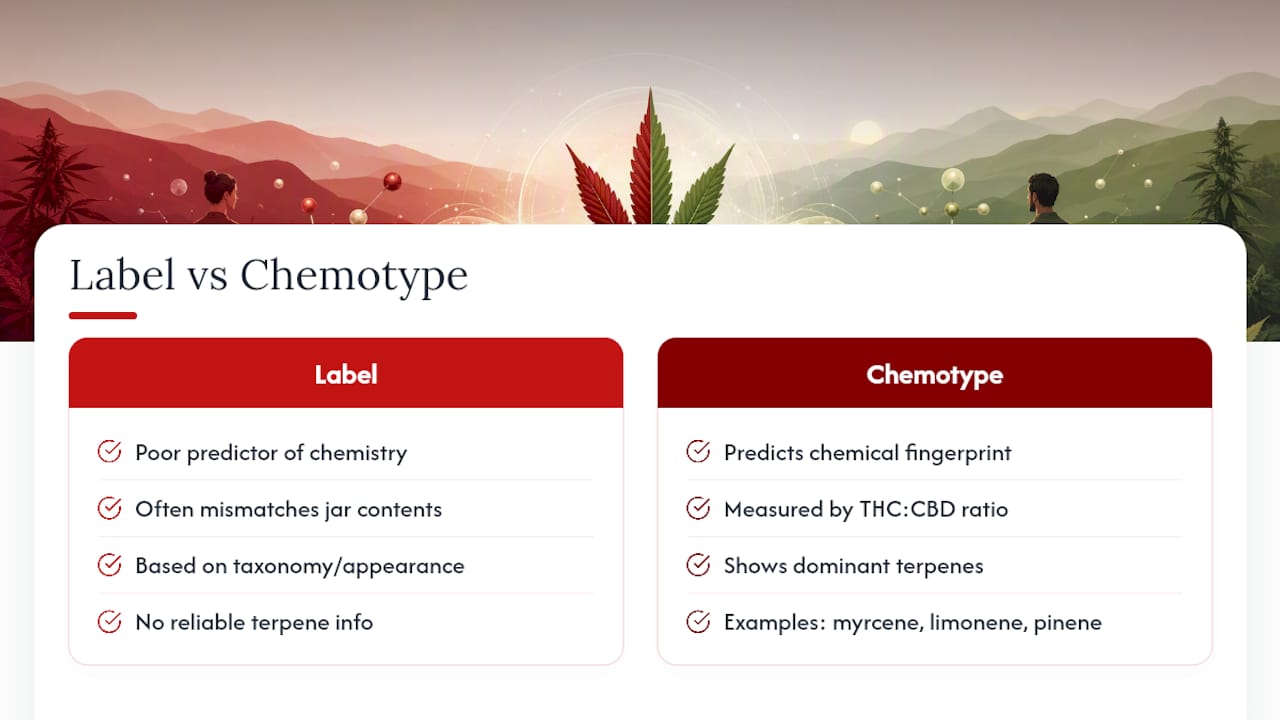
The distinction that consumers rely on when they ask for "an indica" or "a sativa" often has little to do with what's actually in the jar. Chemical analysis of thousands of commercial samples shows labels frequently don't match the cannabinoid and terpene content inside, which is the actual driver of the experience.
This is where the word "chemotype" becomes useful. A chemotype is a plant's specific chemical fingerprint, primarily its THC-to-CBD ratio alongside its dominant terpenes. Myrcene is associated with a heavier, more sedating feel; limonene tends to show up in mood-lifting, citrus-forward profiles; pinene is linked to alertness and may offset some of THC's fog. These compounds interact with cannabinoids to shape the actual experience far more precisely than "indica" or "sativa" ever could.
The practical takeaway: treat the plant-type label as a rough starting point and the Certificate of Analysis (COA) as the real evidence.
How to choose a strain that actually does what you want
Skip the guesswork and work through the chemistry directly. Here's a sequence that works whether you're buying from a dispensary, a seed bank, or a trusted supplier:
- Read the cannabinoid panel first. Check the THC and CBD percentages on the COA. Higher CBD relative to THC generally softens intensity and reduces anxiety risk; a THC-dominant profile with little CBD tends to hit harder and faster.
- Check the dominant terpenes. Myrcene-heavy profiles skew relaxing, limonene-heavy ones skew brighter, pinene adds clarity. This tells you more about the actual feel than the indica/sativa tag on the front of the pack.
- Match the dose to your tolerance and the time of day. A profile that reads "energising" on paper can still overshoot if you take too much, particularly with a low personal tolerance.
- Stick with sources that publish honest, batch-specific testing, and ask for a COA whenever one isn't already provided.
Pro Tip: Keep a simple note of the THC/CBD ratio and top two terpenes for anything that works well for you. That combination, not the strain name, is what you should look for next time.
Key takeaways on indica vs sativa
Chemistry, not the indica/sativa label, determines how a strain actually feels. In practice that means three things:
- Check the COA before you buy, not after
- Pay closer attention to terpene content than to the indica/sativa tag
- Start with a low dose, especially with unfamiliar THC levels, since individual tolerance and body chemistry vary widely from person to person
The Scouse Genetics perspective on why verified genetics matter
Consistency is the real prize in this whole conversation, and it's the piece most sellers skip. At Scouse Genetics, every line goes through phenohunting and germination testing before release, with honest mould ratings attached rather than glossed over. That process is what lets a grower or collector expect the same outcome batch after batch, which is the entire point of caring about chemotype in the first place. If you're browsing Scouse packs or Female packs, remember that seeds are sold as souvenirs and collectibles, so check your own local law before germinating anything.
This article is general information, not a substitute for advice from a qualified doctor. Consult a qualified healthcare professional about your own circumstances before acting on anything here.
Sources
- Indica vs sativa: What’s the difference? — Medical News Today
- The Cannabis sativa Versus Cannabis indica Debate - PMC
- Indica vs. sativa: Science suggests there’s not actually a difference — National Geographic
- Sativa vs. indica: Similarities, differences, and uses — Healthline
FAQ
Is it better to get indica or sativa?
Neither is objectively better. The right choice depends on the cannabinoid ratio and terpene profile, not the plant category, so check the COA rather than picking by label alone.
Is indica an upper or downer?
Indica-labelled products are commonly reported as relaxing or sedating, but this isn't consistent across products, since chemistry varies far more than the label suggests.
Is sativa or indica higher in THC?
Neither category is inherently higher in THC. THC content depends on the specific cultivar and its chemotype, not on whether it's marketed as sativa or indica.
Is sativa or indica associated with more positive mood?
Sativa-labelled products are more often linked to uplifting, energising effects, while indica leans towards physical calm, but terpenes like limonene and myrcene are better predictors of mood impact than the label itself.
Reading the label right
The indica/sativa split isn't wrong so much as incomplete. It tells you what the plant looked like in the field, not what's happening in the jar. Read the COA, note the terpenes, and treat the plant-type label the way you'd treat a nickname: useful for a quick conversation, not for a decision that actually matters.
— Lewis