

Dwarfing genetics and fast, short photoperiod varieties are the safest bet for balconies, terraces and small plots. Little Dwarf, Royal Dwarf, Mighty Mite, Early Girl and a handful of purpose-bred dwarf crosses all stay under a metre outdoors while still finishing with usable yields. Each has a distinct height, flowering window and climate preference, covered strain by strain below.
TL;DR:
- Compact strains like Little Dwarf and Royal Dwarf are most reliable when grown in 20 to 40-liter containers with well-draining soil and full sun.
- Short, predictable flowering windows of 7 to 9 weeks are crucial to avoid autumn rains and reduce mold risk in UK outdoor climates.
- Overfeeding small plants can cause stress and should be minimized, especially since dwarf genetics are more nutritionally sensitive.
- Proper protection from rain and humidity, such as lightweight rain covers angled to shed water, improves bud quality and reduces mold threats.
- Choosing seeds with documented height ranges, explicit flowering times, mold resistance, and germination guarantees ensures reliable results for small outdoor setups.
Table of Contents
- Five compact outdoor strains worth growing this season
- How do you grow compact strains in containers and small plots?
- What should you check before buying seeds for a small outdoor grow?
- Author perspective: what actually works in tight outdoor spots
- Browse verified packs for compact outdoor grows
- Sources
- FAQ
Five compact outdoor strains worth growing this season
Not every "small" strain behaves the same way in a UK garden. Some stays short because of ruderalis genetics that force early flowering, others because of tight indica structure that never stretches much regardless of light. Knowing which is which changes how you plan pots, feeding and support.
Little Dwarf is the benchmark for true dwarf genetics. It reaches roughly 40 to 70 cm indoors and 50 to 100 cm outdoors, with a flowering window of around 55 to 65 days and outdoor yields typically landing between 40 and 80 g per plant. That short life cycle makes it forgiving for growers who only get a few months of decent UK weather, and its size means two or three plants can share a single large tub without fighting for root space.
Royal Dwarf grows a little taller and a little heavier. Outdoor height sits anywhere from 30 to 100 cm depending on pot size and sun exposure, and it commonly finishes flowering in eight to nine weeks with yields of 30 to 100 g per plant. The spread in those numbers isn't inconsistency in the genetics. It's a direct reflection of how much light and root space the plant gets, so a Royal Dwarf in a 30 litre pot on a south-facing patio will out yield the same seed in a shaded corner by a wide margin.
Mighty Mite is the strain to reach for if your garden is more Manchester than Marbella. It's a compact Himalayan indica line bred for cool, short-summer climates, staying around 60 to 90 cm tall with a fast flowering cycle that suits northern outdoor sites needing an early-autumn finish. Breeders favour this kind of quick-photoperiod genetics precisely because it beats the first proper autumn rains, which matters far more in a small garden than in a large field where losing a few plants to mould barely registers.
Early Girl does a similar job from a different genetic angle. It's a classic outdoor workhorse that typically flowers in seven to eight weeks, staying compact outdoors with moderate to high yields. Short, predictable flowering windows like this cut down the number of weeks you're anxiously checking weather forecasts, and they reduce how long dense buds sit exposed to damp UK evenings.
Then there's the broader category of dwarf crosses: strains bred specifically for a bonsai-like habit rather than pure yield. These dwarf crosses have varied heights at maturity within a compact range and are worth considering when stealth matters more than maximum harvest weight.
A quick word of caution across all five: dwarfing genetics are often more sensitive to over-nutrition than tall, vigorous strains. A compact plant simply has less canopy to absorb excess nitrogen, so what looks like generous feeding to a six-foot plant can burn a 60 cm one.
- Little Dwarf: 40 to 100 cm, ~55 to 65 days, 40 to 80 g/plant, best for containers and quick turnaround
- Royal Dwarf: 30 to 100 cm, 8 to 9 weeks, 30 to 100 g/plant, best for sunny balconies with decent pot volume
- Mighty Mite: 60 to 90 cm, fast finish, best for cooler, shorter UK summers
- Early Girl: compact habit, 7 to 8 weeks, best for growers who want to beat autumn weather
- Dwarf crosses: 30 to 100 cm, best for stealth-focused or balcony-only setups
How do you grow compact strains in containers and small plots?
Getting a short strain is only half the job. The other half is matching your container, training and feeding to a plant that simply doesn't have much room to recover from mistakes.
- Choose the right pot volume. Compact strains generally do well in 20 to 40 litre containers. Anything smaller restricts root development and pushes plants towards stress-induced hermaphroditism; anything much larger wastes space without adding proportional yield. Use a free-draining mix with added perlite, since container plants need adequate drainage and full sun exposure to keep a naturally compact habit rather than stretching for light.
- Train gently, not aggressively. Low-stress training (LST) works well on Royal Dwarf and Little Dwarf, bending stems to open the canopy without cutting growth. Avoid heavy topping on true dwarf genetics: you can remove the main advantage the strain gives you, which is a short, sturdy structure that doesn't need staking.
- Protect against rain and humidity, not just cold. A lightweight, removable rain cover, cloche or clear polythene frame does more good than a heated greenhouse for most UK small-space grows. The goal is keeping dense colas dry during flowering, not warming the plant. Angle covers so water runs off rather than pooling on top of the canopy, and lift them on dry, breezy days to let humidity escape.
- Feed moderately and watch the leaves. Dwarf and compact genetics tend to show nutrient sensitivity faster than tall strains, so a lighter feeding schedule, roughly two thirds of the manufacturer's recommended strength, tends to produce sturdier plants and more reliable yields than pushing full-strength nutrients. Clawed, dark green leaves are usually the first sign you've overfed.
- Keep placement discreet. Grouping pots among other leafy container plants, using plain plant tubs rather than branded grow pots, and positioning against a fence line rather than an open balcony edge all reduce visibility without needing any special equipment.
Pro Tip: If you only have room for two or three pots, stagger sowing dates by a week between plants. It spreads out watering and feeding demands, and gives you a buffer if one plant is slower to establish than the others.
What should you check before buying seeds for a small outdoor grow?
The seed listing itself tells you almost everything you need to know before you commit pot space and a whole season to a strain.
Start with photoperiod versus autoflower. Photoperiod plants like Royal Dwarf and Little Dwarf give you control over timing and generally produce heavier yields, but need enough daylight hours to trigger flowering naturally. Autoflowering or fast-finishing genetics suit stealth grows or very short seasons, since they flower on a fixed internal clock regardless of light changes.
Beyond that, work through this checklist on any product page:
- Documented mature height range, ideally with separate indoor and outdoor figures, not a single vague number
- Explicit flowering time or maturity window, stated in weeks rather than "fast" or "quick"
- Mould resistance notes, since this matters more for compact, dense-budded plants in humid UK autumns than for almost any other trait
- A stated germination guarantee, which tells you how the breeder handles non-viable seeds
- Evidence of phenohunting, meaning the strain has been grown and selected across multiple generations rather than sold on marketing copy alone
Treat vague height claims, missing flowering windows, or a complete absence of mould information as red flags. Those gaps usually mean the listing was written to sell, not to inform.
Author perspective: what actually works in tight outdoor spots
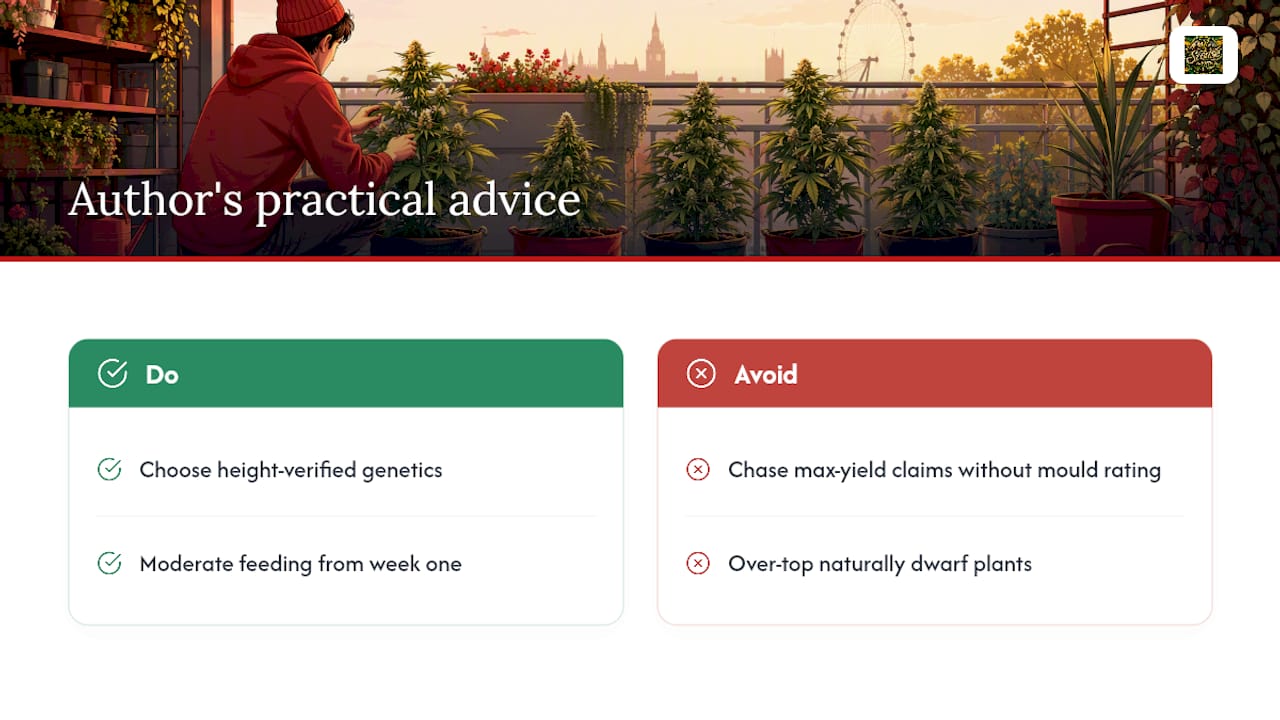
What consistently worked in cramped outdoor plots wasn't the strain with the biggest promised yield. It was the one with the shortest, most predictable flowering window.
Do choose height-verified genetics and moderate your feeding from week one. Don't chase maximum yield figures on a strain with no stated mould rating, and don't over-top a naturally dwarf plant just because you can.
— Lewis
Browse verified packs for compact outdoor grows
Scousegenetics is the practical next step if you've read this far and want seeds you can trust to hit the height and yield ranges you've just planned around. Every pack is phenohunted and germination-tested before listing, with honest mould ratings attached, exactly the two things that matter most when a failed seed means an empty pot for the whole season rather than a minor setback.

That predictability is what suits compact outdoor growers specifically: you know roughly what height and structure you're getting before you commit a container to it. Scouse packs are priced at £60 per pack, and Female packs at £40 per pack, both available to browse now on the Scouse Genetics wholesale page. If you're after something outside the seed range, the merch collection covers branded extras for the same growers.
Sources
A wasted pot costs a large-scale grower very little. It costs a balcony grower an entire season. That's the practical argument for buying from a source that publishes real testing data rather than marketing height ranges.
Scouse Genetics is a seed bank built around that exact problem: seeds that are genetically verified through rigorous phenohunting and germination testing before they're ever listed for sale. Honest mould ratings and a germination promise matter disproportionately when you're only running two or three plants, since a failed seed or an unexpectedly mould-prone phenotype eats time and space you don't have spare. When comparing packs, look specifically for stated height ranges, a mould rating, and a clear germination policy. Those three details tell you more than any strain description.
- Little Dwarf, Zambeza, Hybrid, 8-11 weeks | PhenoDB
- Royal Dwarf Strain: Indica, 19.3% THC — Effects & Genetics | StrainCompass
- Mighty Mite Strain (Himalayan Indica IBL) - Strainpedia
FAQ
What makes a cannabis strain "compact"?
A compact strain typically matures between 30 and 100 cm outdoors, a habit driven by dwarfing or ruderalis genetics rather than pruning alone.
Which strain is best for a small balcony grow?
Little Dwarf suits balconies well, reaching only 40 to 100 cm with a short flowering window of roughly 55 to 65 days and yields of 40 to 80 g per plant.
Do compact strains need less feeding than tall plants?
Yes. Dwarf genetics are generally more sensitive to over-nutrition, so moderate feeding at reduced strength usually produces healthier plants than full-strength nutrient schedules.
How do I protect small outdoor plants from rain?
Lightweight, removable rain covers or cloches work best, angled so water runs off the canopy rather than pooling around dense buds and raising mould risk.
Does Scousegenetics sell seeds suited to compact outdoor grows?
Yes, Scousegenetics offers phenohunted, germination-tested packs with honest mould ratings, with Scouse packs at £60 and Female packs at £40, both listed on the wholesale page.